
The Health Benefits of Seafood: Why Omega-3s Matter More Than Ever

As conversations around health, nutrition, and longevity continue to grow, one food group consistently stands out for its evidence-based benefits: seafood. Across cultures and centuries, fish and shellfish have played a central role in nourishing populations, supporting heart health, brain development, and overall wellbeing. Today, modern nutritional science continues to reinforce what traditional diets have long understood — seafood is one of the most nutrient-dense, health-supportive foods we can eat.
At the heart of seafood’s reputation lies one essential nutrient: Omega-3 fatty acids. These unique fats are fundamental to human health, yet many people in the UK consume far less than recommended. Let’s explore the science behind Omega-3s, the wider health benefits of seafood, and how making informed, sustainable choices can positively impact both personal health and the health of our oceans.
As an award-winning seafood restaurant in Belfast, with core values rooted in health, quality, sustainability, and education, we believe it’s important not only to serve exceptional food — but also to explain why seafood deserves its place at the centre of a healthy diet.
Why Nutrition Matters More Than Ever
January often marks a renewed focus on health. Gym memberships rise, meal plans reset, and people actively seek foods that deliver real nutritional value. Yet lasting health isn’t about restriction or short-term fixes — it’s about nutrient quality, balance, and enjoyment.
The NHS recommends a varied, balanced diet that includes at least two portions of fish per week, one of which should be oily fish. This guidance reflects decades of robust scientific research linking seafood consumption with reduced risk of chronic disease, improved mental wellbeing, and healthier ageing.
Despite this, fish consumption in the UK remains inconsistent, and many people associate seafood with complexity, expense, or indulgence rather than everyday nutrition. In reality, seafood — even classic favourites like Fish & Chips — can be both accessible and highly nutritious when prepared thoughtfully.
What Are Omega-3 Fatty Acids?
Omega-3 fatty acids are essential polyunsaturated fats, meaning the human body cannot produce them on its own. They must be obtained through diet. These fats play a critical role in cell membranes, hormone signalling, and inflammatory pathways.
There are three primary types of Omega-3s:
1. EPA (Eicosapentaenoic Acid)
EPA is best known for its role in cardiovascular health. It supports normal heart function, helps regulate inflammation, and contributes to healthy blood lipid levels.
2. DHA (Docosahexaenoic Acid)
DHA is a structural fat found in high concentrations in the brain and retina. It is essential for cognitive function, memory, visual health, and neurological development across the lifespan.
3. ALA (Alpha-Linolenic Acid)
ALA is found primarily in plant foods such as flaxseed, walnuts, and chia seeds. While beneficial, ALA must be converted by the body into EPA and DHA — a process that is inefficient, with conversion rates often below 10%.
Seafood provides EPA and DHA directly, making it the most effective and bioavailable dietary source of Omega-3s.

The Science-Backed Health Benefits of Omega-3s
Heart Health
Heart disease remains one of the leading causes of mortality in the UK. Omega-3 fatty acids, particularly EPA and DHA, are among the most extensively studied nutrients in cardiovascular research.
Scientific evidence shows that Omega-3s: contribute to normal heart function, help reduce triglyceride levels, improve blood vessel flexibility, support healthy blood pressure regulation, and are associated with a reduced risk of coronary heart disease
Regular seafood consumption is a key feature of heart-healthy dietary patterns such as the Mediterranean diet, which consistently ranks among the healthiest diets in the world.
Inflammation Regulation
Chronic, low-grade inflammation is increasingly recognised as a contributor to conditions such as: arthritis, type 2 diabetes, metabolic syndrome, and cardiovascular disease
Omega-3s play a crucial role in modulating inflammatory responses in the body. Rather than suppressing inflammation entirely — which is essential for healing — Omega-3s help regulate it, supporting balance and resilience.
This is particularly relevant in modern diets that tend to be high in Omega-6 fats, which can promote inflammation when consumed in excess without sufficient Omega-3 balance.
Brain & Mental Health
The human brain is nearly 60% fat, and DHA is one of its most important structural components. Adequate Omega-3 intake supports: memory and learning, cognitive performance, mood regulation, and neurological resilience.
Emerging research suggests links between Omega-3 intake and reduced risk of depression, cognitive decline, and neurodegenerative conditions. While nutrition is only one piece of mental health, Omega-3s are increasingly recognised as a foundational nutrient for brain health across all stages of life.
Eye Health
DHA is a major structural fat in the retina, making Omega-3s essential for normal vision. Adequate intake supports retinal function and may help protect against age-related eye conditions.
This benefit begins early in life — Omega-3s are vital during pregnancy and childhood for visual and neurological development — and continues into older age.
Healthy Ageing
As we age, maintaining muscle mass, cognitive function, and mobility becomes increasingly important. Omega-3 intake has been associated with: preservation of muscle mass, improved physical function, cognitive health, and reduced risk of frailty.
Combined with regular activity and a balanced diet, Omega-3-rich seafood supports long-term vitality, not just disease prevention.
Seafood: More Than Just Omega-3s
While Omega-3s are often the headline nutrient, seafood offers a remarkably broad nutritional profile.
A portion of white fish such as cod or haddock provides: high-quality lean protein, Vitamins B6 and B12 (supporting energy metabolism and nervous system health), Vitamin C, essential minerals including iodine, zinc, iron, and calcium, and is naturally low in saturated fat. Iodine, in particular, is often under-consumed in the UK and is essential for thyroid function and metabolic health.

Fish & Chips: A Healthier Choice Than You Might Think
Fast food often carries a negative nutritional reputation, yet not all takeaway meals are equal. When compared with many popular fast-food options, Fish & Chips can be a balanced, nutritional, and satisfying choice.
Independent laboratory testing has shown that a Fish City small Fish & Chip portion meal contains just 579 calories, making it a competitive option in the fast-food landscape. By monitoring portion sizes, cooking methods, and ingredient quality, it’s possible to enjoy traditional favourites without compromising on health.
Transparency, Education, and Calorie Awareness
Understanding what we eat is essential for making informed choices. That’s why working closely with the Food Standards Agency to monitor calorie and nutritional content has been a priority.
Being the first independent business awarded the ‘Calorie Wise’ certification reflects a commitment to transparency and consumer education. Calorie information recorded across the entire menu empowers guests to balance enjoyment with awareness — without sacrificing flavour or quality.

The Importance of Variety and Sustainability
Health doesn’t exist in isolation from the environment. Sustainable seafood choices help protect marine ecosystems while also encouraging dietary diversity.
Many consumers rely heavily on the so-called “Big Five”: cod, haddock, salmon, tuna, and prawns. Whilst these species can be part of a healthy diet, over-reliance on a limited number of species places tremendous pressure on these fish stocks globally. The best choice for consuming these species is to find them with reputable ecolabels, including the Marine Stewardship Council (MSC) for certified sustainably sourced wild fish and the Aquaculture Stewardship Council (ASC) for certified responsibly sourced farmed fish. Incorporating a wider range of fish and shellfish — such as mussels, crab, trout, and herring — offers key benefits of greater nutritional diversity and reduced environmental impact.
Shellfish like responsibly-farmed mussels are particularly sustainable and nutrient-rich, offering impressive Omega-3 levels with a low carbon footprint.
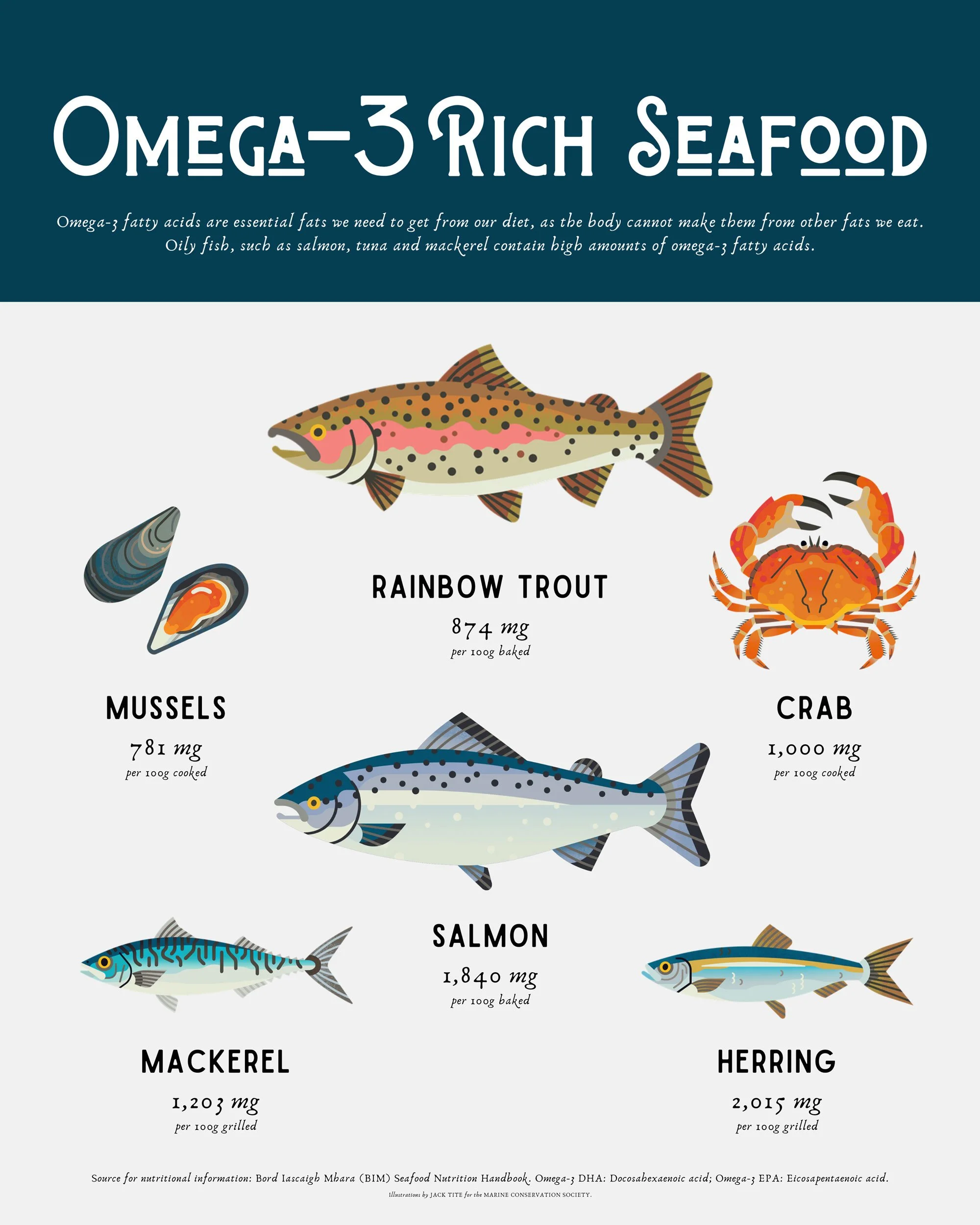
Omega-3-Rich Seafood Choices
According to the Bord Iascaigh Mhara (BIM) Seafood Nutrition Handbook, many commonly available fish and shellfish provide significant levels of Omega-3 fatty acids alongside a broad range of essential nutrients that support overall health.
Mussels – 781mg Omega-3 per 100g
Mussels are one of the most nutrient-dense and sustainable seafood choices available. In addition to Omega-3s, they are an excellent source of high-quality protein, vitamin B12 (essential for energy metabolism and nervous system health), iron, selenium, and iodine. Mussels are also naturally low in fat and calories, making them a powerful option for supporting heart health and immune function.
Rainbow Trout – 874mg Omega-3 per 100g
Rainbow trout provides a balanced nutritional profile, delivering Omega-3 fatty acids alongside vitamin D, selenium, and potassium. Vitamin D plays a key role in bone health, immune function, and muscle strength, while selenium contributes to antioxidant protection. Trout is also a high-quality protein source, supporting muscle maintenance and satiety.
Crab – 1,000mg Omega-3 per 100g
Crab meat is naturally lean yet rich in essential nutrients, including zinc, copper, selenium, and vitamin B12. Zinc supports immune health and wound healing, while selenium contributes to thyroid function and antioxidant defence. With its low fat content and high mineral density, crab offers nutritional benefits well beyond its Omega-3 contribution.
Mackerel – 1,203mg Omega-3 per 100g
Mackerel is one of the richest natural sources of Omega-3 fatty acids and is also high in vitamin D, vitamin B12, iodine, and selenium. These nutrients collectively support bone health, cognitive function, energy production, and thyroid regulation. As an oily fish, mackerel is particularly effective at delivering EPA and DHA in a highly bioavailable form.
Salmon – 1,840mg Omega-3 per 100g
Salmon is widely recognised for its Omega-3 content, but it also provides substantial amounts of vitamin D, vitamin B12, selenium, and high-quality protein. These nutrients contribute to immune support, muscle health, and nervous system function. The combination of healthy fats and protein makes salmon especially beneficial for heart health and long-term metabolic wellbeing.
Herring – 2,015mg Omega-3 per 100g
Herring is one of the most Omega-3-rich fish available and delivers additional benefits through its high vitamin D, vitamin B12, iodine, and selenium content. These nutrients support bone health, brain function, thyroid health, and energy metabolism. Herring is also a small, fast-growing species, making it a nutritionally powerful and environmentally responsible choice.

Building a Healthy Habit, Not a January Trend
While January often sparks motivation, true health comes from consistency. Incorporating seafood into weekly meals is one of the simplest, most enjoyable ways to support long-term wellbeing.
Whether it’s a comforting portion of Fish & Chips, a shellfish dish rich in Omega-3s, or a seasonal seafood special, choosing fish isn’t about perfection — it’s about progress.
Let the Sea Do the Work
Seafood offers a rare combination of proven health benefits, culinary pleasure, and sustainability potential. Omega-3 fatty acids play a central role in supporting heart, brain, and metabolic health, while seafood as a whole delivers essential nutrients that modern diets often lack.
By choosing a variety of responsibly sourced fish and shellfish, enjoying them in balanced portions, and understanding their nutritional value, we can make healthier choices that benefit both ourselves and the planet. Because when healthy food is genuinely enjoyable, it’s not a sacrifice — it’s a pleasure.
ReferencesAquaculture Stewardship Council (ASC): https://asc-aqua.org/Bord Iascaigh Mhara (BIM). Seafood Nutrition Handbook: https://bim.ie/wp-content/uploads/2021/03/BIM-Seafood-Nutrition-Handbook-Final.pdfMarine Stewardship Council (MSC): https://www.msc.org/ukNHS: Fish & Shellfish: https://www.nhs.uk/live-well/eat-well/food-types/fish-and-shellfish-nutrition/